Labels

Showing posts with label Products. Show all posts

Thursday, September 6, 2012

Crusty's Out of Here deal #1

OK, so now that everyone knows that I have three so weeks left as the owner of My Mountain I am going to take the chance to dish out some rocking deals.  Especially when Ben has left early for the day and has left me in charge !  :-)

So this is the deal....   We have 1 x 17" Superfly AL.   I'm going to do this for $1,699

But here is the deal, if you are in our customer database and have registered purchases against your name.  You can have another $50 OFF !
$1,999.00
$1,799.00


Tuesday, July 31, 2012

Santa Cruz Tallboy LT Carbon


The newest addition to the Santa Cruz family the Tallboy LTc has provoked huge excitement from our customers and the first two orders have arrived today. The large yellow and medium black will be be kitted out with the SPX AM build (full Shimano XT groupsets) and Fox 34 140 29 forks. Sweet!

If you are interested in the Tallboy LT, we have access to a large alloy demo bike, this shares the same geometry as the carbon and will give you a good indication of how well these bike handle technical trails.


Wednesday, June 27, 2012

Santa Cruz Blur TRC Ex-demo bike sale


We have medium and large Santa Cruz Blur TRC ex demos for sale. Both bikes are in amazing condition and have done less than 300k's. These are a blast to ride, corners like it's on rails with a geometry that gives amazing confidence riding technical fast terrain, all this fun weighs only 11.4kgs in a medium size.

Both bikes have the same build: Full Shimano XT Groupset (3 x 10), XT Ice Tech brakes, DT Swiss wheels, Fox Float 130 RLC Kashima forks and Kashima RP23 shock.

Give us a call or drop in for pricing and a test ride.


Friday, June 15, 2012

Focus Izalco - bike of the year


To celebrate the Tour de France Focus bikes have a pretty sweet gear up deal going on the award winning Izalco road bike.  Take the Focus Izalco 3.0 as an example; The MM price for this bike is $3,799 and comes with a full set of Focus riding kit with bidden cages, and bottles. But that's just one example, every Focus Izalco bike comes with all the swag, take your pick. Free stuff is free stuff ! 

Focus Izalco Pro 4.0 Ultegra

The "entry level" spec for the Focus carbon Izalco frame, the Pro 4.0 gets a Shimano Ultegra drivetrain couples with a BB30 crankset and DT Swiss wheels


Focus Izalco Pro 1.0 Dura-Ace


Get onto the incredible Izalco carbon road bike from Focus that features a BB30 bottom bracket, Tapered head tube and internal cable routing

Monday, May 7, 2012

Light up the dark.


It’s that time of year again, days are short, nights are long and cold. Instead of sitting on the couch drinking beer, get out and ride! Night riding is amazing fun and will give you a whole new perspective on your usual trails. A powerful, reliable set of lights are essential, British company Exposure lights produce some fine examples to get you out there.

Exposure lights are designed and manufactured in the UK and are made to an extremely high standard, not only in light performance but in also in finish. The light bodies are built from CNC aerospace grade aluminium and resemble the finish found on a Thomson seatpost or stem. All lights in the range are one single battery and light unit with no wires needed, just snap into the supplied Exposure light bracket and off you go. Exposure produce a large range of lights from which we have cherry picked what we feel to offer the best value and performance.

Maxx-D

The Exposure Maxx D sits second from top of the range and packs an impressive punch considering its price. The Maxx- D will pump out 1285 lumens for an impressive 3 hours on full power, medium and low settings will increase run time from 10 to 24 hours respectively. Run times can be increased further by plugging in either the 1 cell or 3 cell piggyback battery. The Maxx-D is a favourite among the 12 and 24 hour enduro crowd, especially when teamed up with the helmet mounted Diablo.

Diablo

This light is a favourite at MMHQ as it produces 975 lumens from a tiny package that weighs only 124g. This amount of light is more than enough for a quick spin after work, with run times ranging between 1, 3 and 10 hours. The Exposure Diablo comes standard with a helmet mount but can also be handlebar mounted for a super bright commuter set up, especially with it’s eye burning flash setting. The Diablo’s run times can be doubled or quadrupled with the piggyback batteries which plug into the back of the light and can be run into a jersey pocket or Camelbak.

Joystick

The Exposure Joystick is perfect for commuters needing to see where they are going on those unlit bike paths. Available in both helmet and handlebar mount options the Joystick has 3 power settings and a flash mode to ensure visibility in traffic. Max power is 325 lumens, more than enough for the commute to and from work. Even with it’s affordable price tag the Joystick still uses the same Cree XPG LED’s as found in the Diablo and Maxx D.

Flash/Flare Combo

This tiny but impressively powerful lightset is designed for visibility rather than vision. If your commute is all on lit streets, these are some of the brightest lights available. The Exposure Flash and Flare are rechargeable with their removable, rechargeable batteries and supplied charger. Fitting is easy with the rubberised straps which simply wrap around either the handlebar or seatpost.

Friday, April 20, 2012

Santa Cruz Blur LTc - good for the soul


It had been a long week packed with all the stresses a busy week can bring. I was tyred, cranky and a bit over it, so needed something to remove me from the world and re-charge the batteries.  A solo mountain bikes session was just what the Dr ordered, and so I decided I would sneak off for some quality time with myself, a bike, some nice trails and fresh air.  So once that was decided I had but two decisions to make; where to go, and what to ride.  The where to go was a foregone conclusion as it hadn’t been raining for a couple of weeks and I had received word that the trails at Wombat state forest were in great condition. So Wombat Forest it was to be.  Now all was left to decide was what to ride, a great conundrum to have.  One of our good Customers Dave had just pulled the trigger on a new Santa Cruz Blur LTc and the frame was hanging up in store waiting to be built.  At the same time we had a medium Blur LTc demo bike sitting on the floor which I took as an ordained sign.  A Blur LTc, myself, and some great trails on a Sunday morning….life is great!

Having not ridden a Blur LT before I was pretty excited to see how the Santa Cruz suspension would suit this type of bike.  The 140-160mm travel range is an interesting category as the character of a bike can change dramatically by the geometry that is matched with the travel.  Slack and short, and you have yourself a min-downhill type of bike.  Steeper angles, with a longer cock-pit gives you a trail bike with buckets of capabilities, and that’s exactly what the LTc is.  Light, snappy, fun, with some extra travel in its back pocket for when you decide to hit up some of those bigger obstacles.  Of all the SC bikes I have ridden the Blur LTc is by far my favourite. For me it felt like one of those magical bikes that you could do just about anything on. And if you can only have one bike….well heck, make it a lightweight, responsive 140mm trail bike.  Race, all day epic rides, those 1 metre drop-offs.  It loves it all, and I love it back as the best Santa Cruz ever.

So is this post about the bike, the ride, or the combination of the two and what it can do for your sanity.  I think it’s the lot. I thought the bike was the most capable SC bike I have ridden as far as “one bike to rule them all” goes and it helped me ride away the stressed of the world for a whole Sunday morning delivering me back home, happy, content and muddy with a smile on my face.  So although not everyone is lucky enough to be able to jump on new and different bikes all the time, everyone has the ability to get away from it all and enjoy some quality time with just you, your bike, and the trail.  So get out there, you will feel better for it! 

Tuesday, March 20, 2012

Give your bike the love it deserves! Muc-Off Bike Cleaner Range @ My Mountain


Muc-Off Bicycle Cleaning Products
With Winter fast-approaching us along with the inevitability of riding through crummy trail conditions, there is never a better time of year to get yourself prepared to keep your bike clean and running in tip-top condition. While some riders may leave bike maintenance up to the My Mountain Mechanics, there are some simple & effective products you can use at home to keep your bike running smoothly and to avoid excessive wear & tear.
With many products and brands available on the market, none of them quite have the same comprehensive range as UK brand Muc-Off, as well as a strong commitment to biodegradable ingredients. Everything from cleaners, degreaser, chain lube, brush kits, frame protection, apparel cleaner and all sorts of other products make up the massive MucOff lineup. While we stock a substantial part of this range, we've cherry-picked what we see as the most useful products for our customers, which you can see both in store and online. What you'll read here is a brief overview of the range, but to skip the infomercial, head on to our Bike Care range.


Muc-Off Bike Cleaner
This is an absolute must-have for any cyclist. There is nothing on the market that comes close to making bike cleaning this easy and it's effectiveness at washing away dirt, grease and grime away from your bike. Distinctive by its pink spray bottle, you simply give your bike a hose down with water (low-pressure only on your bike!) spray on the Muc-Off Bike Cleaner on all components and let it foam up for 5-10 minutes. It's safe on suspension parts, brakes, carbon fiber and anything else on your bike so it is a true all-over cleaner. Give the bike a rinse with the hose and watch all the mud and dirt magically wash away!
We use a bottle of Muc-Off out the back of the shop for cleaning our customers & our own bikes, and if you've ever seen the condition of our in store demo fleet, you'll realise how well this stuff does its job. You can buy the cleaner in 1 litre or 5 litre bottles and every road & mountain biker should have one in their garage.
To read up more or purchase online, check out the Muc-Off Bike Cleaner here.


Muc-Off also make a range of specific drivetrain degreasers for removing more stubborn filth from your chain, cassette & chainrings. The solvent-based Muc-Off Chain Cleaner is an exceptionally effective solution for blasting off greasy dirt from your chain and can be paired up with the Chain Doc for a super easy degreasing.
Before coming into the workshop with your squeaky disc brakes, try using the Muc-Off Disc Brake Cleaner to remove any contaminants from your rotors or pads. It's a great way to finish off your bike cleaning session, as it dissolves and blasts away any residue oil or grease that may have made its way onto your braking surfaces, removing them before they can contaminate your pads.


Detailing & Polishing
There are some really cool products in the range for detailing the frame and components on your bike to keep them shiny and protected from the elements. While many riders may scoff at the idea of buffing their bike, the main purpose of using these products is to actually protect the finish on your bike and create a slippery surface that dirt and grease won't be able to stick to. An awesome product for your drivetrain is called Muc-Off Bike Spray, which is a Teflon-based aerosol that leaves a smooth and slippery surface on metallic components to prevent rust & corrosion. It disperses any residue moisture and makes an ideal after-wash
treatment that will avoid the nasty buildup of greasy dirt on your bikes gears. Muc-Off Silicone Shine is a convenient spray that is designed as to protect the surfaces on your frame, wheels and suspension components while adding a beautiful shine. Not only safe on suspension seals, it actually helps reduce surface friction and is a great way to keep your forks and shock feeling smooth between services. And for the real enthusiasts out there who want to do the job properly, you can't do better than the Muc-Off Miracle Shine. Anyone who has buffed their car with Turtle Wax will know what we're talking about here. Miracle Shine is a liquid wax that is applied with a Microfiber cloth such as the blue one pictured, adding a substantial coating to surfaces such as your frame, suspension lowers, cockpit items, wheels, cranks - and any other components that you want to look ridiculously shiny. The main benefit of using Miracle Wax over the Silicone Shine or Bike Spray, is that it is a much more durable coating that lasts longer and provides more protection against scratches and dirt build up. You won't need to apply it often, but you will be giving yourself high-5's when you do as it will make your bike look like it's just left the showroom floor.

Along with cleaning cloths, Muc-Off make a comprehensive range of cycling-specific brushes and brush kits to help the cleaning process. Check out the Bicycle Brush Set and the Pit Kit 8-in-1 to see some examples of what we have on offer.

We could talk for hours about cleaning and maintaining your bike, and you will notice we have added in some tips for cleaning under each product listing to help you with the whole process. However, if you have any questions about where to start or what's the best method for cleaning a specific component - drop into the Brunswick store or shoot us an email and we'll be more than happy to share our experience with keeping bikes running smooth for the long haul.

In the meantime, check out this video from Muc-Off that takes an overview of their cleaning range.

Thursday, February 23, 2012

Drivetrain Wars - The 10 Speed Battle of SRAM vs. Shimano (Part 2)

Continuing on from our previous drivetrain discussion, the second half of our review will be covering the Shimano 10 speed offerings available @ My Mountain, as well as alternative gearing options and how to choose the right setup for you and your riding style.

Shimano
In response to SRAM's release of the 2x10 XX groupset, Shimano hit back the following season with it's latest XTR drivetrain in a 10 speed guise dubbed 'Dyna-Sys'. However, unlike SRAM, Shimano debuted the groupset in 2 distinct flavours titled; Trail and Race, which provided riders with multiple choices for front cranksets, cassette ratios and derailleur options depending on their needs. The idea was to create a groupset that wasn't just designed for hardcore XC racers, but was also suitable for trail riders who valued the lightweight, high quality shifting and performance that is synonymous with the XTR name. While SRAM have been pushing the whole 2x10 system, Shimano are offering both 3x10 and 2x10 options in their XTR, Deore XT and SLX groupsets as they have recognised the importance of choice when it comes to gearing setup. Firstly, a quick rundown of the available 10 speed options from Shimano;

Shimano XTR: The absolute top of the tree in the world of Shimano, with intensively machined components for super crisp shifting and lighter weight. The HollowTech crankset lays the power down like no other and the Carbon/Titanium chainrings could be mistaken for a piece of art. Shifting is more positive on the M980 groupset compared to previous XTR drivetrains, but you still get silky smooth and stealthy shifting from the Japanese Juggernaut.
  • Buy Me: If you want the smoothest shifting available and value lightweight parts
  • Don't Buy Me: If you think replacing a worn Titanium cassette is cheap


Shimano Deore XT
Stepping up for 2012 with a redesign on the cranks, shifters and derailleurs, the Deore XT groupset sees some significant trickle down technology from the XTR line with the introduction of a double crankset. Like XTR, you get the choice of 'Trail' and 'Race', so you can choose how low or high your gearing needs to be. XT is known as "the standard" for mountain bikes, as aside from some carbon, titanium and a few grams, it is very close to XTR in performance.
  • Buy Me: If you need dependable components with a utilitarian appeal
  • Don't Buy Me: If you want sexy carbon on your bike or you're looking for the lightest component options


Shimano SLX
Also seeing the 10 speed Dyna-Sys treatment is the true workhorse of the Shimano lineup, SLX. While Deore XT continues to be whittled down to its lightest form yet, SLX takes a slightly burlier approach with its solid rear derailleur and beefy crankset that are likely to stand up to more abuse over more km's. Shifting performance is still Shimano-slick, but currently they only offer a triple crankset up front.
  • Buy Me: If you want bulletproof performance and you are hard on your gear
  • Don't Buy Me: If you want a dedicated 2x10 setup or you're counting grams


Choosing the right drivetrain setup for you
While that's all well and good, there's no need to drop everything and become a 'SRAM Fan' or 'Shimano Enthusiast', until you work out what drivetrain setup is best for you, your bike, your riding style and your riding conditions. As cliche as it may sound, it is not uncommon to see a weekend warrior heaving their way up a hill on a SRAM XX-equipped bike that is clearly geared to highly for their terrain and fitness levels. You can have all the carbon and acronyms in the world, but if you have to think, and we mean consciously think about your gears while riding, then you don't have a setup that works seamlessly for your conditions.

2x10
Without doubt the latest buzz in the mountain bike industry, the 2x10 drivetrain has had a real push by SRAM, first with the XX groupset and now with the X0 and X9 lines too. There are some clear benefits of running a double front crankset such as improved ground clearance, less front shifting, narrower Q-Factor and lighter weight. However, low gearing availability is not its forte and although those options are starting to become available, they are an aftermarket addition that can raise the initial costs up. Also, many full suspension bikes are designed to perform optimally around a 32t middle chainring, and so slapping on a 2x crankset with a 36 or 38t chainring will likely cause a certain amount of 'stiffening' of the suspension. Not a hugely noticeable issue, but worth mentioning nonetheless.
  • Who it works for: Anyone wanting to simplify their current triple setup should look at gearing options on a 2x10 system. If you don't think you'll miss the super low/high gears a 3x9 drivetrain offers, you could find a 2x10 setup to have more usable gears with less overall front shifting.
  • Who it doesn't work for: If you feel that having a 38t or 40t main ring is just too big to push for average trail riding, a dedicated 2x10 setup won't be ideal. Some terrain requires a super low 22/24t granny chainring, and if you find yourself on those kinds of trails regularly, you will still want to go with a 3x10 drivetrain.

3x10
We regularly have customers questioning the need for a 30 speed mountain bike, and it is true that most riders going to the new 10 speed setups are more drawn towards a 2x10 setup. However, the smoother shifting offered by the tighter ratio cassettes is a step up in performance from existing 9 speed options, and with the introduction of the 11-36t cassette option, Shimano has shrunken the gaps between the chainrings on their triple cranksets to 42-32-24t instead of the older 44-32-22t. This makes front shifting faster and more accurate, with less of a jump between shifts.
  • Who it works for: Riders who spend most of their time in the middle 32t chainring and use most of the cassette range for the majority of their riding conditions. If you've got long, arduous climbs in your neighbourhood and couldn't live without a small chainring, don't believe the marketing hype and stick with a triple crankset for its versatility.
  • Who should avoid it: Anyone that finds a granny ring more useful as a paper weight than an actual gear. If you're a big ring smasher, you will love the higher ratio double cranksets such as the 42-28t option from SRAM or the 38-26t option from Shimano.
Note: For 29er's, All Mountain bikes and anyone riding terrain where a granny ring is essential, you can still have a 2x10 setup without having to go with a dedicated double crankset. The picture on the left is of a 10 speed XT crankset that has had the 42t chainring removed, and replaced with a bashguard. The conversion is relatively straight forward, as you don't require any new components. Aside from swapping in the bashguard, all you need to do is wind in the upper limit screw to stop the derailleur from moving past the middle chainring. The reason you would do this is if you find the big chainring on a triple crankset mostly useless for your riding, but really appreciate the 32t middle ring and having the small chainring for climbing. And 'hey presto'; a 2x10 setup that can easily be changed back to a 3x10 arrangement if you decide you can't live without your big ring.


1x10
Starting to increase in popularity due to the advent of wide-range 11-36t 10 speed cassettes, the single chainring setup is becoming more feasible thanks to the increased range offered out back. While single chainring setups have been around on DH and Freeride bikes for some time now, All Mountain and XC riders are starting to warm to the concept and appreciate the simplicity and improved chain retention offered. Remove the front shifter, front derailleur, additional chainrings and a few chain links and all you need to do is choose the right chainring size for your riding (32, 34 and 36t are most popular) and use some kind of chain device in lieu of the front mech (E*13 XCX as in photo), and you've got yourself a reliable and simple drivetrain solution.
  • Who it works for: Simpletons with big legs. If you replace your middle chainring about 5 times before any other chainring, there's a good chance a 1x10 drivetrain is all you really need for your riding conditions. The increased chain retention and snappier shifting from a shorter chain is noticeable on rough terrain and great for aggressive riders.
  • Who should avoid it: Like a 2x10 system, any rider who requires a low climbing gear will struggle with a single front chainring. Likewise, on most XC racetracks you will be pining for a 38t-42t big chainring that this option does not provide. If you have dodgy knees, you're best off with a drivetrain setup that has a low climbing gear.


While we understand that there are many confusing drivetrain options available to us these days, and it seems like each magazine or press release tells us to use a different setup that what the last one said, there are no doubts that there is a suitable option for your bike and your riding style. By going off previous experience, you can determine fairly easily what are the gears you really use, and what gears are mostly redundant for your riding. Don't be pressured into buying the 'macho' race-specific setups if you're not the racer type, as those gearing ratios will not be useful for 90% of riders out there.

If you like what you've read but have a few more specific questions about what groupset you want to fit to your new bike, or how to modify your existing setup to better suit your legs, by all means drop us a line or come into MMHQ in Brunswick to further discuss your available options. We would love to share our experience with the new 10 speed groupsets and help your decision making in getting the right setup for you.

Tuesday, February 14, 2012

Who's thirsty? Huge new Camelbak range now in store and online


We've always been big fans of Camelbak hydration packs as riders ourselves, but we've taken things a step further by recently becoming an official Camelbak dealer. Those regular My Mountaineers will know we've been stocking a select few packs over the past 2 years such as the Mule and Lobo bags, but for 2012 we decided to expand the range to include additional sizes, Womens specific packs and a whole range of accessories for those chasing parts for their existing bladder.

We're particularly excited about some of the new packs such as the Charge LR pack (blue pack pictured) that features a brand new Lumbar Reservoir that positions the Antidote bladder around the lower half of the pack instead of lengthwise. It's designed to lower the centre of gravity of the pack while placing more of the weight onto your hips as oppose to your shoulders.
Check out the Camelbak Charge LR here.


Also part of the new range in stock is the female-specific Aurora backpack. It joins a line of 3 Womends Camelbak models that feature a more contoured harness that is designed to be more comfortable for ladies, particularly if wearing a sleeveless top. The models feature different sized bladders and storage volume, so you can pick the ideal pack based on your riding demands. Check out the Camelbak Aurora here.


As we are now stocking a bigger range of Camelbak hydration packs, we are able to pass on better pricing to you on all the new 2012 packs. The Mule is an absolute classic in the Mountain Bike lineup and features some new tricks and improvements for 2012 to keep it on top. There are still 2 versions available; the standard Mule and the Mule NV. THe NV features a much better quality harness that provides a butt-load more ventilation that is a must for Aussie conditions. While the standard Mule is cheaper, we only choose to stock the NV model as we believe it is a much better quality pack. With a recommended retail price of $179.95, we are able to offer the Mule NV at a lower price of $154.95. Like the rest of the website, we provide these lower prices all year round to all of our customers; no waiting for unnecessary sales, no need to worry about others getting a cheaper price than you - just great pricing all the time with no gimmicks.


We have also taken delivery of a range of the Camelbak bottles. While some MTB folk will scoff at the idea of not using a hydration bladder, a bottle can often be a better choice, particularly for after work rides where you don't need a huge reservoir of water. Taking their bladder technology to the world of bottles, the Podium water bottles use a BPA-free construction with the same HydroGuard lining used in the bladders for taste-free drinking.
Our pick is the Big Chill Podium bottle on the right, as it uses a dual-layer insulation system for keeping fluids cooler. This is the perfect bottle for Summer days, as there is nothing worse than going for a swig of water that turns out to be luke warm, urgh.
The Podium water bottles start from $17.95 and you can check them out here.


For those already using a Camelbak, we have replacement bladders and bladder accessories for keeping the scunge away and breathing some life into your old pack. The entire 2012 Camelbak range utilises the redesigned hydration bladder called the "Antidote". The same bladder is now also available on its own so you can fit it to your existing pack. Aside from being lighter and slimmer, the Antidote gets what we reckon is a revolutionary closure lid that locks shut in a 90 degree turn. The amount of times we have over-tightened the closure lid on the previous Omega bladder and have battled to try and get it unstuck is not worth mentioning here! The hose is now also removable from the bladder and makes refilling/cleaning much, much easier.

Checkout more info on the Camelbak Antidote Bladder here.


Though with that lovely new bladder, you're going to want to keep it clean and in tip-top condition right? Camelbak make a number of cleaning solutions for keeping your reservoir fresh and free of contaminants. We always store our bladders in the freezer between rides to stop any bacteria from growing, but it will still find its way in there eventually and when it does, these cleaning tablets will kill and remove any nasties. Simply dissolve in water and clean out the bladder and hose with a brush kit, then rinse and hang out to dry completely before using again.
The tabs come in an 8pk for just $19.95 that will give you 2-3 years worth of cleaning if you clean out the bladder every 3 months.

If it's time for a new hydration pack or you just need to spruce up your existing reservoir, we've got a great new range available from Camelbak to suit every rider out there. Check em out in store or online here; Hydration & Bottles.

Sunday, February 12, 2012

Drivetrain Wars - The 10 Speed Battle of SRAM vs. Shimano (Part 1)


Looking back on the past 24 months in BikeLand, it seems as though every fortnight a new revolutionary product is hitting the market, such is the pace of advancing technology in modern day mountain bikes. It kinda feels like we’re being bombarded by new bottom bracket standards, steerer tube sizes, drivetrain options, thru-axles, carbon fiber layups and suspension technology, making it hard to sift through the marketing spiel to see what is actually going to improve your riding. At the end of the day, a lot of these innovations are genuinely better than the component they replace, but whether it means anything to you, your riding style, riding conditions or budget is an entirely different kettle of fish.

Today’s example; The 10 speed Drivetrain.


10 Speed – what’s it all about?
While road bikes have been using an extra gear for a few years now, Mountain Bike 10 Speed was only introduced by the impressive XX groupset from SRAM back in late 2009. The 10 speed drivetrain shook up a somewhat stagnant market by adding an additional cog to the cassette to rework gearing ratios. The big push from SRAM was to use a double crankset up front instead of the usual triple, made all the more viable by a wide-range cassette out back. Instead of 11-34t ratio used on 3x9 drivetrains, the new 2x10 system got a big 11-36t cassette ratio, allowing for a similar high and low gear, with more usable shifts in between (think of all the gearing overlaps there are in a 3x9 system). What we are seeing now are a whole new range of drivetrain setups with both triple, double and single front chainring options, with riders being able to select the perfect setup for their riding style and track conditions.
However, along with a heavy marketing push, we’re also seeing many riders on setups that aren’t suited to their local trails or riding style.

Aside from gearing ratios, there are 2 other advantages of a 10 speed drivetrain. The first is smoother shifting, as the extra cog in the cassette provides smaller changes between each sprocket size, allowing for an easier transition for the chain between gears. The second is a stronger chain (converse to what many think) as the rollers of the chain are shorter than on a 9 speed chain, resulting in less flex and a higher torque rating. Sure you can still bust a chain from mis-shifting, but overall they’re stronger and the wear rate appears to be no different from 9 speed options, if not slightly better.

SRAM
Being the purveyor of 10 speed, SRAM have certainly gone deep into the new platform, with 5 different groupset levels available from the World Cup XX, down to the entry-level X5 groupset. While SRAM are still making triple cranksets, they believe that with the new 11-36t cassettes out back, most riders can benefit from downsizing to a double crankset to reduce front shifting and are really pushing the whole 2x10 shebang. However, up until now the available chainring sizes for their 2x cranks have been a little tall for our liking, making us recommend triple cranksets for weekend warriors, 29er riders and those frequenting steep terrain (the smallest double chainring option being 39/26). For 2012, SRAM have recognized that some of their gearing options were too high for all but XC riders and racers, and so have introduced new 2x chainring ratio options as an aftermarket upgrade (such as a 38/24 option).

SRAM XX: Superlight and super trick parts that make up SRAM’s top-tier groupset.. Lots of carbon and Titanium, and the CNC machined cassette is a real work of art. Available crankset ratios include 39/26t and 42/28t, with the cassette coming in both 11-32t and 11-36t.

  • Buy Me: If you’re building the ultimate lightweight bike and want the best there is.
  • Don’t Buy Me: If you’re not XC racing and you require lower gearing options.

SRAM XX Groupset 2x10 Speed


SRAM X0: Not a whole lot cheaper than XX, but many similar technologies in a package for more aggressive riders. Sweet carbon cranks, punchy trigger shifters and a bomber rear derailleur that is available in 3 cage lengths. Also available for 2012 is the X0 DH groupset with specific cranks and rear derailleur.

  • Buy Me: If you have a carbon fetish and want bulletproof and lightweight
  • Don’t Buy Me: If you’re on a budget and need to spend money on other thing…such as food.

SRAM X0 Groupset 2x10 Speed

SRAM X0 3x10 Groupset

SRAM X0 DH Groupset 1x10 Speed


SRAM X9: Excellent value gruppo with trickle-down technology from the XX components. Not quite as slick and punchy in shifting as its bigger brothers, but hollow alloy cranks are stiff and overall weight is very good.
You can get a triple crankset and the double in both 39/26t and 42/28t following the X-Glide 1:1.5 ratio for uber-fast shifting up front.
  • Buy Me: If you like chunky SRAM shifting and love the 2x10 concept.
  • Don’t Buy Me: If your main concern is weight – you’ll have to go higher up.

SRAM X9 Groupset 2x10 Speed

SRAM X9 Groupset 3x10 Speed


What do you think of the whole 10 speed movement? Is it as good as your previous 9 speed drivetrain? Do you think SRAM have the 2x10 market stitched up or is this one big marketing fad you want to avoid? Let us know what you think and leave a comment below.

Tune in next time for our in-depth look at offerings from Shimano, as well as other drivetrain options currently spreading into the market.

Wednesday, January 11, 2012

2012 Trek Slash 8 - it's a whole lot of bike!


With the arrival of the all new Trek Slash 8 I was excited to see how the changes would feel from the amazing Scratch Air 9 that we had the pleasure of riding throughout 2011.  The clever guys at Trek had decided to almost start again and design an all-mountain rig with a specific purpose in mind.  Avalanche style DH races.  Their reasoning was sound, as Trek always design bikes with specific purposes in mind, which in turn drives development.  So for 2012 the all new Trek Slash 8 comes with a redesigned rear-end that includes a DRCV shock and tweaked geometry,  a mino-link that allows riders to adjust the head angle by ½ a degree and raise the bottom bracket by 8mm, and the very neat Rockshox stealth dropper seat-post.

Around this time last year we un-packed our Scratch demo bike in time for a trip to Mt Bulla where some true all mountain riding could be had, and 2012 would see history repeating itself with Mt Bulla the destination to put the Trek Slash 8 through its paces. Without riding the bikes back to back it is very hard to pinpoint the improvements or differences between the two, so instead I can only write about how the Slash felt and performed as a standalone all new all-mountain steed.

Having not been on bigger travel bikes for a little while it took the first couple of hours to settle into the Slash’s full capability, while the bike itself took some time to get going with the suspension and brakes needing to heat up, and bed-in making everything work together seamlessly. It has to be said that Fox 36 forks really do need a descent flogging before they will run smooth, but once the Talas 160 Kashima coated forks did settle in, they became plush, direct, and most importantly felt good through the bottom 3rd of their travel, which I was using very regularly down the Glen Jacobs designed Stonefly trail at My Bulla.  The only thing that makes the Fox Talas forks seem not as smooth and plush as they could be, is the rear suspension on the Slash, with the new DRCV shock performing so well it defies logic.  

With a trail like stonefly where you are hitting big G-out  type dips and humps one after another for an extended time, air based suspension can have a habit of getting too hot and dramatically loose performance over the course of the run.  But the Fox DRCV shock just seems to recover hit after hit without complaint.  It would probably suffer on some of the epic descents found in Canada, but for our Australian big mountain trails the DRCV equipped Slash is right at home and will take anything you, or the trail can throw at it.

Of course the other advantage of the Trek's propriety suspension is at the top end of the travel.  With DRCV the shock behaves like a short-travel, standard Fox float, allowing you to put the power down to maintain some speed on flat sections as well as climb quite well.  Sure you aren't going to win the next short-course XC event on this beast, but it does go up hill with remarkable efficiency.  With some effort you should be able to keep up with your riding mates on  short travel XC bikes on the up-hills, then completely smoke them on the descents.  You will be the one with the big smile, trust me.

Apart from the major jump to a DRCV suspension platform, the other changes that come as a welcome improvement is the internally routed cabling for the shifting and Rockshox Reverb post.  Both not really performance upgrades, but rather a neater more aesthetically pleasing look that for many will be a nice touch.  So who out there will want the 2012 Trek Slash 8 ?  Anyone who wants to have the most amount of fun possible on a mountain bike, with access to some more technical trail networks that will give them  the opportunity to use the bike to at least some of it’s potential.  And it has a lot of potential! 

Thursday, December 1, 2011

My Mountain presents: 2012 Santa Cruz Blur TR Carbon

With the new models, build kits and fork options currently arriving from the Santa Cruz factory in California, we have overhauled our website to update the entire 2012 range for your viewing pleasure. Some frames have been updated and some are completely new, with most coming down in price compared to 2011. All of the high-end models see the option of Fox Kashima suspension for forks and rear shocks, while the new 2012 build kits are even better value with an option for every budget.

For more information, check out Santa Cruz Bicycles here.

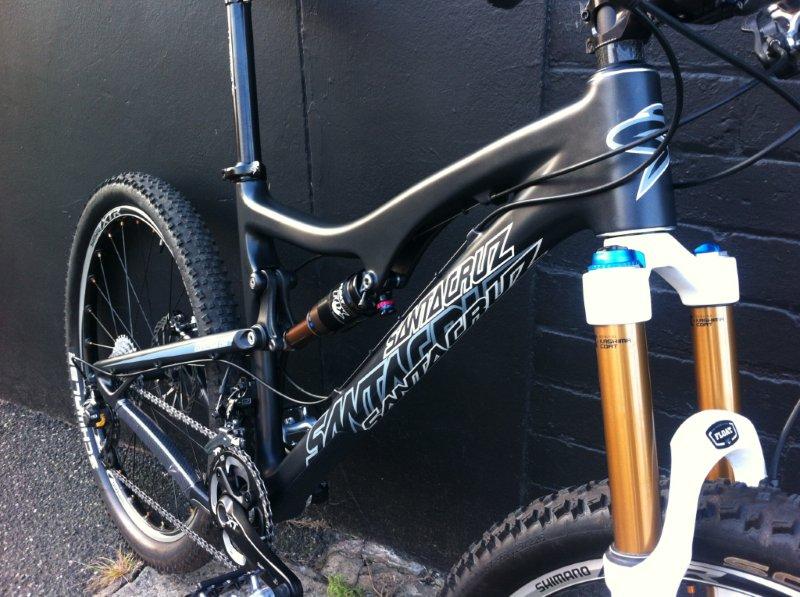
Being Santa Cruz’s premium Victorian Dealer, we have recently made the move to invest in a pair of gorgeous Santa Cruz Blur TR trail bikes for our in store demo fleet. Dressed in a 2012 SPX build kit and Fox Kashima suspension front & rear, we have both a Medium and a Large size available for those folk who are keen to try out the VPP suspension before pulling the trigger. While many will already be familiar with the ride quality of Santa Cruz bikes, we understand that there are some folks who just need the extra assurance of getting the tyres onto dirt before handing over your hard earned moolah. Though in the case of the Blur TRc, we would be very surprised if you didn’t come back grinning ear-to-ear after a test ride!


Left; The Gold Kashima Fox Shock keeps the rear suspension supple and allows it to react to the smallest trail chatter. Right; Integrated Carbon protection is used on the chainstays, seatstays and along the down tube to the BB to keep the frame looking new for longer.


The Santa Cruz Blur TRc is a new 5” travel trail bike from Santa Cruz Bikes that features all of the latest frame and suspension technology going. Built upon a low slung frame that features a slack 68 degree head angle, the Blur TR is a modern trail bike designed to provide a playful nature. The Carbon frame weighs just 2.2kg’s including the Fox RP-23 Kashima rear shock, but maximises chassis stiffness thanks to some unique engineering techniques such as the continuous carbon fiber construction around key frame junctions. The heralded Virtual Pivot Point suspension design is employed on the Blur TRc frame in the VPP2 guise that provides a smoother, more linear action to the rear travel, without sacrificing the pedal efficiency you would expect from a Blur series bike.


The stout mini-links that control the axle path of the rear triangle use Angular Contact Bearings to provide a flex-free interface to aid bearing life. Combined with the one-piece carbon rear triangle, the Blur TR is a laterally stiff frame that responds to all of your input out on the trail and holds its line through berms and off-camber corners.


Left; Lower VPP link dictates the axle path for square-edge hit response. Right; Grease ports for the Angular Contact bearings in the lower linkage.


Although the rear pivots are super simple to pull apart and maintain, additional grease ports on the lower link allow you to pump in fresh grease when required. It all adds up to a strong, durable and stiff frame that backs up its good looks with impeccable trail manners.


Whilst we’ve only just received our Blur TR’s, they have already received a lot of attention from staff that have had the pleasure of test riding them. With it’s short chainstay length, low BB height and slack head angle, the Blur TR feels like a big BMX bike that wants you to act like a hooligan – it just rips!

Just like the rest of the Santa Cruz range, the Blur TR is available as both a frameset and as a complete bike. You can choose from a variety of fork options, build kits and colours with our very own bike builder, though if you're looking to create your dream machine we can also custom build from the frame up. Check out the complete Santa Cruz Blur TR Carbon or the Santa Cruz Blur TR Carbon Frame for pricing and further details.

If you want to know more about the Blur TR or any other Santa Cruz bike, come past the shop or drop us a line on the phone or via email; we’ll be happy to talk your ear off about them!

Sunday, November 20, 2011

The Trek Superfly 100 - 12 months on a Carbon 29er

Back in late 2011, I made a somewhat controversial jump into the world of 29er dual suspension mountain bikes. The decision came after I had the pleasure of test riding the Superfly 100 at the Trek World dealer show in Canberra in September. Out of all the new bikes I got to ride over those 2 days on the trails of Mt Stromlo, the Carbon 29er stood out to me as one of the fastest and most stable XC bikes I had ever ridden, and was an experience that was echoed by pretty much every other dealer I spoke to. Although I had only recently upgraded my current mountain bike, the lure of the shiney Black & White carbon frame was just too much to handle and I sought to do anything that was necessary to make it mine.

Although I would have loved to have gotten the blingy X0 specced Superfly 100 Elite, my unglamorous bike shop employee income somehow didn't allow me to stretch to an $8k budget so I had to settle with the "entry level" version. My plan was to ride the snot out of this bike, slowly upgrade parts as I would see fit and monitor the performance changes as I swapped out new components to end up with a bike just how I want it.
When people think of a Custom Build, they generally visualise a frame being built up with specific components before it is complete. In my case, my custom build started with a complete bike that has evolved over time. Listed below are some of the changes I have made as well as some comments on how those components have affected the bike out on the trail.

Suspension
For the stock Trek Superfly 100, the suspension was never particularly shabby but it did lack some of the adjustment that comes on the higher end dampers from Fox. The stock fork is a Fox F100 29er fork with adjustable air pressure, rebound and lockout, while the shock is a Float RP2 that shares the same external adjustments. What I really wanted for the rear suspension was a Boost Valve equipped shock for a more consistent feel over rough terrain, as I had been finding the stock RP2 to be a little overwhelmed when facing repeated hits and high-speed chatter. The 2012 Fox RP23 rear shock comes equipped with both Speed and Position sensitive damping and so features a consistent and controlled feel all the way through the travel. The latest Adaptive Logic model can also be custom tuned by Fox in Sydney before it even goes on the bike; Boost Valve pressure, Velocity tune and Rebound tune are all tweaked for the Superfly 100's leverage ratio. I've had my shock set up to the stock Trek settings to start off with, though may play around with the tune down the track.
Up front, the Fox Float 29 RLC fork was quite the mission to acquire, due to the need for the G2 crown offset to maintain the Trek's nimble handling. With a slightly further offset crown, the fork took about 6 weeks to arrive from Fox USA, though it was well worth the wait. The closed FIT cartridge was the big reason I upgraded, as in a similar way to the Boost Valve in the rear shock it increases the dampers consistency over choppy terrain. Adjustable low speed compression makes a noticeable affect in reducing brake dive and the "wallow" I was getting on steep switchbacks. Both the fork & shock feature the Gold Kashima coating that reduces seal friction and combined with the redesigned SKF wipers, makes for a buttery action - oh and the gold finish looks sweet too!


Wheelset
After I had decided I was decking the SF100 out with new suspension, the logical upgrade for the fork was to with a QR15 thru axle to stiffen up the front of the bike and improve steering response. To do that however, would require a new front wheel, and, well let's be honest, a new rear wheel to match. DT Swiss 240 hubs on Mavic TN719 rims with DT Swiss Supercomp triple butted spokes make for a reasonably light but bulletproof, and more importantly, stiff wheelset. Jerry spent many hours sweating, lacing, tensioning, cursing, de-stressing and truing up these wheels, and the end result is a very high quality artisan build that I just couldn't get from factory built wheels. Out on the trail the difference is quite remarkable, and I have found both acceleration and handling response to have improved ten-fold over the stock wheels.
Wrapping the rims is a set of Maxxis Ignitor tyres in their 29er EXO format, which are designed as an all conditions tyre that emphasises grip over rolling resistance. Compared to Racing Ralphs or Ikons, they're certainly not as fast rolling on smooth terrain but once things get loose they hold on with impressive traction and allow me to hold a line with much more confidence. Combined with the 29er wheels and ABP rear suspension on the Superfly, I rarely find myself skidding or breaking traction - the bike just sticks to the ground like glue.


Cockpit
While perhaps not full of necessary upgrades, the cockpit on my SF100 has seen a couple of changes in pursuit of that "just right" setup that achieves the balance of comfort, control and stability. Changing out the bar to the carbon Bontrager RXL flatbar was motivated by a desire to try a different sweep, though thus far I'm not convinced of the 660mm width, having previously run a 690mm wide bar. The narrower stance has reduced some of the stability from the bike, though the trade-off has been faster steering through tight singletrack.
Changing out the stem to a Thomson X4 was a pretty obvious choice, though I really splashed out on the Masterpiece seatpost and carbon-railed Bontrager Evoke saddle, which dropped a substantial amount of grams from the bike.


Drivetrain & Brakes
Nothing particularly unusual here, though I did swap the 42t chainring for an E*13 Turbocharger bashguard as I found I was only using the big ring as a pseudo-bash plate anyway. 2x10 Drivetrain is quite slick, though I am tempted to go for a single ring setup up front in the pursuit of simplicity and reduced weight... Brakes were swapped out for the 2012 Shimano XT Brakes, which look very shiny and neat with their stout brake lever designed for one-finger braking. Pedals are Crank Brothers Eggbeater 3 units, and no; I didn't purposefully set out to match the bikes paintjob, but yes; they do look fantastic on there don't they! I certainly prefer the extra float and ease of entry/exit that the Eggbeater pedals provide and have used numerous sets on my bikes over the years.


All in all, a pretty sweet setup if you ask me. A reasonable amount has changed on there since the bike first emerged from it's cardboard box, but I find it's part of the fun of owning a mountain bike that becomes your personal ride. Sure, not everything on there is perfect or was a fantastic choice, but learning how each component affects the bike and thusly the overall ride is an excellent learning experience that each one of us @ My Mountain goes through with their own bikes.
Keep an eye out for future updates on the SF100 as I'll do my best to detail my experiences over time with the bike and it's components. And if you have any questions or comments about any particular parts on the bike, feel free to post them below.

Happy endTrails
Wilis